
The Science of Water as a Solvent
Perfectly balanced water finds it own equilibrium (LSI=0)
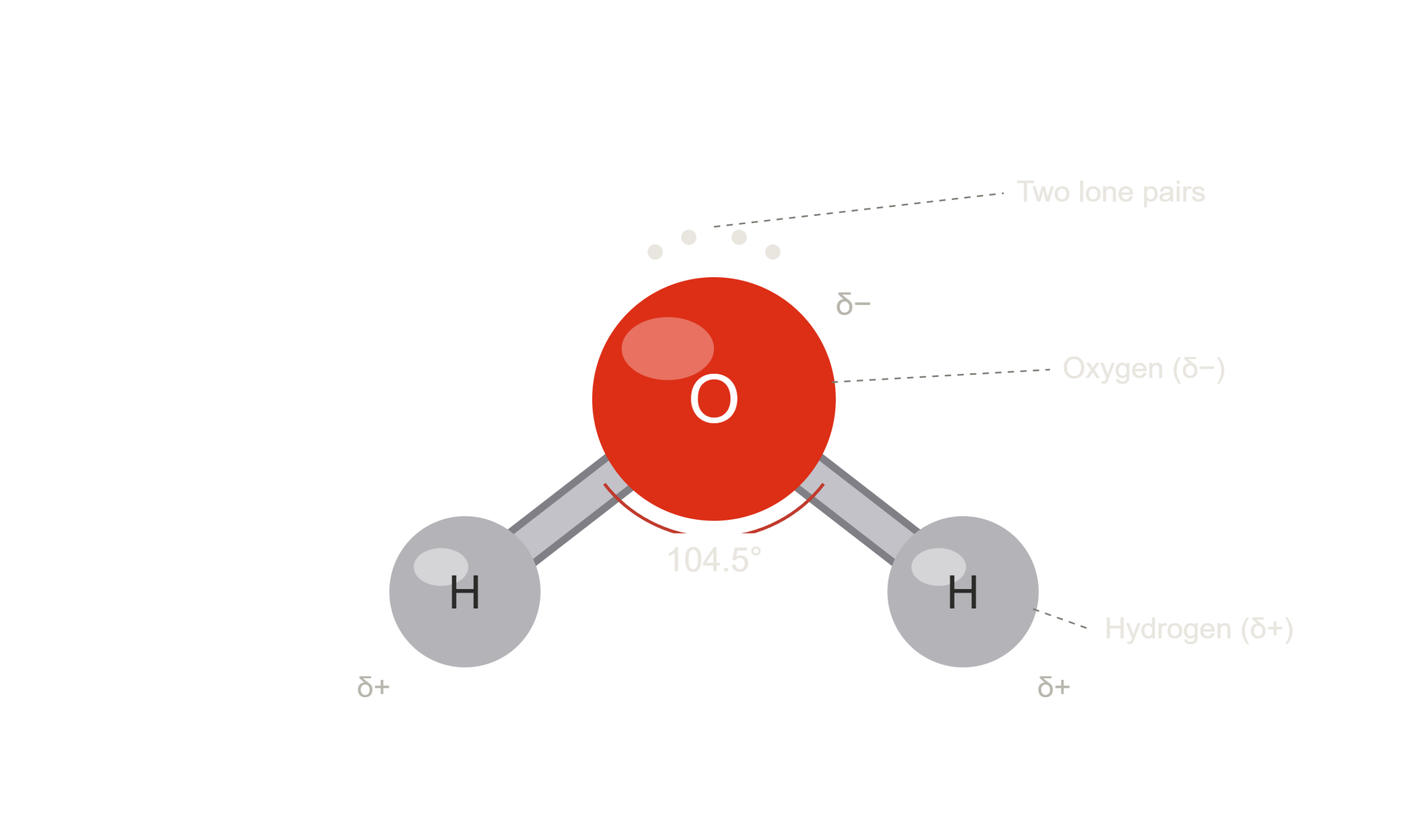
Water: A Special Molecule
A water molecule (H2O) is made up of two hydrogen atoms, which each carry a slight positive charge (δ+), and one oxygen atom, which carries a slight negative charge (δ−). This difference in charge creates a polar molecule: one side is slightly positive and the other slightly negative.
Because of this, water is an excellent solvent: it can surround and bind both positive and negative ions, allowing substances such as salts to dissolve easily.
Why Water Dissolves Salts (Ion Hydration)
When table salt (NaCl) dissolves in water, it splits into sodium ions (Na+) and chloride ions (Cl−). Water molecules surround these ions, forming solvation shells (hydration shells):
- The negative oxygen side points toward Na+ (the positive ion)
- The positive hydrogen side points toward Cl− (the negative ion)
These hydration shells stabilize the ions in solution and keep them apart, so that they do not immediately recombine into solid salt.
Investigating How Water ‘Sticks’ to Ions
Scientists Michel Kropman and Huib Bakker developed a method to observe how tightly water molecules stick to dissolved ions. They used a short laser pulse to give energy to the hydrogen atoms in the water molecules, making them vibrate relative to the oxygen atom.
In pure water, these vibrations fade quickly. When water molecules are attached to ions such as Cl−, the vibrations last longer. This is because heavy ions such as chloride (mass ≈ 35) or iodide (mass ≈ 127) do not absorb the vibrational energy well, so the water molecules attached to them keep vibrating for longer.
Water’s Bond Angles and Structure
The hydrogen atoms in water form a bond angle of about 104.5 degrees at the oxygen atom, creating a bent shape. This shape helps water molecules form hydrogen bonds with one another and surround and stabilize ions in solution.
Key Takeaways
- Water molecules form stable, long-lasting structures around ions in solution
- These structures make it harder for ions to move freely
- Ion hydration controls the speed of chemical reactions by holding ions within hydration shells
- Water not only dissolves substances but subsequently also helps keep surfaces clean