
Calcium Carbonate Balance in WaterAnalysis, interpretation and applications
Ponds • Swimming pools • Plumbing installations • Process water • Cooling water
1. Introduction
The calcium carbonate balance is a fundamental concept in water chemistry. It determines the extent to which water tends to dissolve or precipitate calcium carbonate (CaCO₃) — better known as limescale or scale. In addition to calcium, magnesium and other dissolved minerals also contribute to the scale-forming properties of water. This balance has a direct impact on the service life of installations, the quality of process water, and the cost of maintenance and treatment.
This paper explains the concept for four practical domains:
- Ponds and ornamental water features
- Swimming pools and recreational water
- Plumbing installations in buildings
- Industrial installations: process water and cooling water systems
In all of these applications, the same three parameters play a central role: GH (total hardness), KH (carbonate hardness or alkalinity) and pH. The interplay between these three determines whether water is in chemical equilibrium, or whether it behaves aggressively or tends to precipitate scale.
2. The parameters: GH, KH and pH
2.1 GH — total hardness
GH (General Hardness) measures the total concentration of calcium and magnesium ions (Ca²⁺ and Mg²⁺) in the water. It is expressed in degrees of German hardness (°dH) or in mg/l CaCO₃ equivalent.
- Soft water: < 6 °dH
- Moderately hard water: 6–12 °dH
- Hard water: 12–18 °dH
- Very hard water: > 18 °dH
An excessively low GH makes water aggressive: it dissolves calcium carbonate out of cement work, concrete pipework and other pond infrastructure. An excessively high GH promotes scale formation as the pH or temperature rises.
2.2 KH — carbonate hardness (alkalinity)
KH (Carbonate Hardness) measures the concentration of bicarbonate (HCO₃⁻) and carbonate (CO₃²⁻) ions. It acts as a pH buffer and largely determines the stability of the water system.
A high KH ensures a more stable pH and reduces the likelihood of sudden fluctuations. A low KH leaves the system vulnerable to pH instability and reduces the effectiveness of disinfectants or corrosion inhibitors.
2.3 pH — acidity
The pH expresses the concentration of hydrogen ions on a logarithmic scale. In the context of the calcium carbonate balance, what matters most is the difference between the measured pH and the saturation pH (pHₛ, or Langelier pH):
- pH < pHₛ: water is undersaturated — it dissolves scale (aggressive water)
- pH = pHₛ: water is in equilibrium — no precipitation, no dissolution
- pH > pHₛ: water is supersaturated — scale may precipitate
pH-GH-KH balance graph with 3 zones and isocontour lines
3. The saturation pH and the Langelier index
The saturation pH (pHₛ) is the pH at which the water is exactly in equilibrium with respect to calcium carbonate. It is calculated on the basis of GH, KH, temperature and the ionic strength of the water. A simplified approach:
Langelier Saturation Index (LSI) LSI = pH(measured) − pHₛ(calculated) LSI < 0: water is aggressive (dissolves scale) LSI = 0: chemical equilibrium LSI > 0: water precipitates scale Figure: How the LSI relates to the condition of a pipe wall: aggressive water (LSI < 0) corrodes the wall, balanced water (LSI = 0) leaves it clean, and scale-forming water (LSI > 0) narrows the bore. |
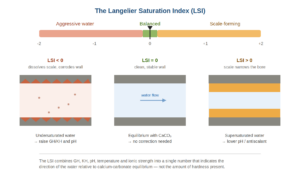
The Langelier Saturation Index (LSI) is the instrument most widely used in industry to assess the scaling tendency of water. For cooling water systems and process installations, the Ryznar Stability Index (RSI) or the Puckorius Scaling Index (PSI) is used as a refinement of the LSI concept.
Index | Value | Meaning | Typical measure |
LSI | < −0.5 | Strongly aggressive water | Raise GH or KH, raise pH |
LSI | −0.5 to 0 | Slightly aggressive | Monitor, adjust if necessary |
LSI | 0 | Chemical equilibrium | Ideal condition |
LSI | 0 to +0.5 | Slight scaling tendency | Lower pH or add antiscalant |
LSI | > +0.5 | Strong scale formation | Descale, lower pH, dosing |
4. Ponds and ornamental water features
In ponds and ornamental water features, the calcium carbonate balance is directly related to the biological stability of the ecosystem. An unbalanced system affects not only the chemical water quality, but also the growth of aquatic plants, the health of fish and the development of algae.
4.1 Recommended values for ponds
Parameter | Recommended range | Critical limit |
GH | 8–14 °dH | < 4 or > 20 °dH |
KH | 6–12 °dH | < 3 °dH |
pH | 7.0–8.0 | < 6.5 or > 8.5 |
4.2 The role of CO₂ and photosynthesis
In ponds, biologically produced CO₂ plays an important role. During the day, aquatic plants and algae consume CO₂ through photosynthesis, causing the pH to rise. At night, biological activity produces CO₂, causing the pH to fall. This day–night cycle can lead to a pH fluctuation of more than one unit.
A sufficient KH (at least 6 °dH) is required to buffer these fluctuations. At a KH below 3 °dH, the pH can drop so low in the early morning that it becomes harmful to fish and other aquatic organisms.
4.3 Scale formation in ponds
In ponds, scale formation manifests as a white deposit on pumps, filters, UV units and decorative stones. When a high pH coincides with a high GH, calcium carbonate precipitates and forms a white, crystalline layer that is difficult to remove.
Preventive: monitor pH, optimise CO₂ dosing or the biological balance. Curative: a descaling product or a citric acid solution (use with caution, not when fish are present).
5. Swimming pools and recreational water
In swimming pools, water chemistry is closely regulated for reasons of hygiene, user comfort and protection of the installation. Here the calcium carbonate balance does not stand alone, but interacts with disinfection (chlorine, bromine, UV) and the overall water balance.
5.1 The water balance in swimming pools
The water balance of a swimming pool is conventionally assessed using the Langelier Saturation Index (LSI). An LSI between −0.3 and +0.3 is generally targeted. Outside this range, risks arise:
- LSI < −0.3: corrosion of concrete basins, metal pipework and heat exchangers; eye irritation in swimmers
- LSI > +0.3: scale formation on walls, floors, heat exchangers and filter media; reduced effectiveness of chlorine
5.2 Effect on chlorine efficiency
The disinfecting action of free chlorine is strongly pH-dependent. At a pH of 7.2, approximately 66% of the free chlorine is present as hypochlorous acid (HOCl), the active disinfecting form. At pH 8.0, this proportion falls to less than 25%. An excessively high pH — often a consequence of a high KH left uncorrected — therefore leads to greatly reduced disinfection despite a high chlorine concentration.
5.3 Scale formation in swimming pools
In swimming pools, scale formation manifests as:
- White deposits on walls (waterline scale)
- Scale crusts on heating elements and heat exchangers
- Clogging of filter media (sand, DE filter)
- Deposits on pumps and pipework
Treatment involves lowering the pH (hydrochloric or sulphuric acid in metered quantities) and backwashing the filters regularly. For stubborn deposits, descaling agents based on phosphonate or polyacrylate compounds may be used as antiscalants.
6. Limescale formation in plumbing installations
Limescale in plumbing installations is one of the most common problems in buildings with hard water. It leads to higher energy costs, a shorter service life of appliances, reduced flow in pipework, and aesthetic problems on taps, showers and tiles.
6.1 Mechanism of scale formation
Scale formation in plumbing installations occurs when hard water is heated. As the temperature rises, the solubility of calcium carbonate decreases, causing it to precipitate. This process is accelerated by:
- High water temperature (> 40°C): particularly critical in boilers and water heaters
- Long residence time of water in the system
- Turbulence at pressure-reducing valves, bends and constrictions
- A high GH combined with a high pH
6.2 Consequences in plumbing systems
Component | Effect of scale formation |
Boiler / water heater | Reduced efficiency, overheating, shorter service life |
Taps and shower heads | Clogged spray holes, reduced flow |
Pipework (copper, steel) | Narrowing of the bore, increased pressure drop |
Washing machine / dishwasher | Detergent residue, damage to the heating element |
Coffee and water appliances | Taste impairment, damage to the heating element |
6.3 Prevention and treatment
6.3.1 Water softeners (ion exchangers)
An effective preventive measure is a central water softener based on ion exchange. Calcium and magnesium ions are replaced by sodium ions, which sharply reduces the GH.
It should be noted that calcium and magnesium do not need to be removed for health reasons, but rather to prevent maintenance problems in installations. The use of salt brings additional considerations: salinization of the environment, suitability for users on a restricted-sodium diet (the elevated sodium content), and a recurring cost for the salt together with the associated logistics and storage.
6.3.2 Phosphate dosing
Phosphate compounds (polyphosphates) form a protective film on metal surfaces and prevent scale formation without lowering the GH. Applied via small dosing devices on the water inlet. Dose: typically 2–5 mg/l orthophosphate equivalent.
6.3.3 Physical, chemical-free techniques
It has been known for years that magnetism can alter the crystal structure of scale towards aragonite, which is less prone to forming biofilm.
We offer the more efficient technologies, such as electronic signal treatment and heterogeneous catalysts.
6.3.4 Curative descaling
For existing deposits: products based on citric acid, lactic acid or (diluted) hydrochloric acid. The correct concentration and contact time are important. After treatment, rinse and, where appropriate, apply an environmentally friendly technology.
7. Limescale formation in industrial installations
7.1 Process water
In industrial processes, water quality is a critical production factor. Scale formation in process installations leads to:
- Loss of heat transfer in heat exchangers: a 1 mm scale layer increases energy consumption by approximately 10–15%
- Clogging of membranes in reverse osmosis (RO) systems
- Disruption of pH-sensitive processes (pharmaceuticals, food industry, semiconductors)
- Damage to pumps, valves and instrumentation
- Microbiological growth — the scale layer provides shelter for biofilm
7.2 Effect of biofilm and scale on pipework and heat exchangers
Biofilm and scale both cause fouling in pipework and heat exchangers, but their effect on performance differs considerably due to differences in thermal conductivity, structure and adhesion behaviour. Biofilm is thermally more insulating than scale, whereas scale tends to lead more quickly to stubborn mineral deposits and the narrowing of flow cross-sections.
Effect on pipework and heat exchangers
In pipework, biofilm leads to higher flow resistance, greater pressure drop and an increased risk of microbiologically induced corrosion. In heat exchangers, biofilm creates an additional thermal resistance at the wall surface, which reduces heat transfer and increases energy consumption.
Scale, or calcium carbonate, likewise causes additional thermal resistance, but its effect per equal layer thickness is generally smaller than that of biofilm, because the thermal conductivity of scale is higher. In practice, biofilm and mineral scaling frequently occur in combination, with biofilm even accelerating the deposition of inorganic particles and crystals.
Thermal properties
The strong impact of biofilm is associated with its low thermal conductivity of around 0.6 W/m·K. For calcium carbonate, a thermal conductivity of approximately 2.3 to 2.9 W/m·K is cited, which makes biofilm roughly four times more insulating at equal thickness.
Material or deposit | Typical thermal conductivity |
Biofilm | approx. 0.6 W/m·K |
Scale / calcium carbonate | approx. 2.3–2.9 W/m·K |
Carbon steel | approx. 16–43 W/m·K |
Copper | approx. 386–400 W/m·K |
These differences explain why a thin organic layer on a metal surface can have a disproportionately large influence on overall heat transmission, particularly with materials such as copper that have a very high thermal conductivity.
Known reductions in heat transfer
The reported percentages are not universal constants; they depend on the material, the flow conditions, the type of heat exchanger and whether local or overall system performance is considered. Nevertheless, several sources provide useful orders of magnitude for the decline in heat transfer or thermal efficiency.
Deposit | Thickness | Reported effect on heat transfer / efficiency |
Biofilm on copper | 1 µm | approx. 30% reduction |
Biofilm on copper | 5 µm | approx. 67% reduction |
Biofilm on copper | 10 µm | approx. 81% reduction |
Biofilm on stainless steel | 10 µm | approx. 31% reduction |
Biofilm on carbon steel | 10 µm | approx. 22% reduction |
Biofilm, generic field case | 20 µm | approx. 30% drop in thermal efficiency |
Biofilm on stainless steel | 100 µm | approx. 50% reduction |
Biofilm on copper | 100 µm | approx. 98% reduction |
Scale / scaling | 1 mm | more than 10% efficiency loss |
The spread between these figures shows that biofilm in particular can have a large effect very quickly on highly conductive metals. For scale, fewer fine-grained tables of thickness versus efficiency loss are available, but the literature and field sources consistently indicate measurable efficiency loss from relatively modest layer thicknesses onwards.
Different types of biofilm
Not every biofilm behaves identically, because its composition, density, water content and the presence of extracellular polymeric substances (EPS) influence its thermal and hydraulic impact. In technical water systems, this usually involves mixed biofilms of bacteria, algae, fungi and organic matrix, rather than a single pure species.
For heat transfer, a distinction is mainly drawn between biological fouling and mineral scaling, and less between individual microbial species. As a result, there are few reliable, broadly applicable percentage tables per specific biofilm species, whereas clear data do exist for layer thickness, material type and the general fouling category.
Technical interpretation
For the design and management of heat exchangers, it is useful to regard biofilm and scale as different resistance layers in series. A thin biofilm layer can already greatly reduce heat transfer, while subsequent mineral deposition aggravates the problem further and complicates cleaning.
In installations with copper components, the relative performance impact of biofilm is generally greater than in steel, precisely because the base material itself conducts so well. For condition monitoring, trends in fouling factor, pressure drop, temperature approach and cleaning frequency are often more informative than visual inspection alone.
7.3 Reverse osmosis (RO) and nanofiltration
RO membranes are particularly sensitive to scaling. Concentration polarisation at the membrane surface means that the local GH and KH are higher than in the bulk water. The LSI at the membrane surface can be significantly higher than the bulk LSI.
Common guideline for RO systems The LSI of the concentrate (retentate) should generally not exceed +0.5 without antiscalant dosing. With an antiscalant, this can be raised to +2.0 or higher, depending on the product and the test results. |
We advise limiting the use of antiscalants based on phosphonates, polyacrylates or phosphinocarboxylic acids, and using appropriate environmentally friendly physical methods instead.
7.4 Steam installations and boilers
In steam boilers, the feedwater is treated to prevent scale formation on heat-transfer surfaces. At high pressure and temperature (> 100°C), calcium carbonate is practically insoluble. Even a thin scale layer can lead to localised overheating (hot spots) and cracking of the boiler tube.
- Feedwater treatment: deaeration, pH correction, phosphate dosing
- Continuous monitoring of conductivity and pH
- Regular blowdown to control salt concentrations
- Use of softened or demineralised water as feedwater
7.5 Cooling water systems
Cooling towers and recirculating cooling systems are particularly susceptible to scale formation owing to the concentration effect: water evaporates but the minerals remain behind. The concentration factor (CF), or cycles of concentration (CoC), indicates how strongly the minerals are concentrated relative to the make-up water.
Cycles of Concentration (CoC) | GH increase | Risk of scale formation |
1 (once-through cooling) | No concentration | Low (depending on the groundwater) |
2–3 | 2–3× higher | Moderate — monitoring advisable |
4–6 | 4–6× higher | High — antiscalant or acid treatment |
> 6 | > 6× higher | Critical — intensive water treatment required |
7.5.1 Cooling water treatment
The calcium carbonate balance in cooling water is controlled through:
- Lowering the pH with sulphuric or hydrochloric acid to reduce the LSI
- Antiscalant dosing (phosphonates, polyacrylates)
- Blowdown control based on conductivity or chloride content
- Corrosion inhibitors (combined products with scale inhibitors)
- Biological control (biocides) to prevent biofilm-induced corrosion
Point of attention: microbiological interaction Scale deposits provide a sheltered environment for micro-organisms, including Legionella pneumophila. In cooling towers, the combination of scale and biofilm constitutes an elevated risk. Moreover, Legionella also survives in the presence of air bubbles. These microbubbles can be reduced by physical water treatment until they no longer pose a danger of microbiological contamination and survival. Regular inspection, cleaning and disinfection are legally required in many European countries. |
8. Comparative table: application areas
Application | Critical parameter | Risk of low GH/KH | Risk of high GH/KH | Target LSI |
Pond | KH (buffer) | pH instability, aggressive water | Scale formation on pumps | 0 (±0.5) |
Swimming pool | pH + LSI | Corrosion of concrete basin, eye irritation | Scale on walls, chlorine loss | −0.3 to +0.3 |
Plumbing (building) | GH (hardness) | Rarely problematic | Scale in boiler, taps | n/a (quality standard) |
RO / membrane | LSI of concentrate | Accelerated membrane ageing | Scaling, membrane damage | < +0.5 (bulk) |
Steam boiler | GH of feedwater | Corrosion | Hot spots, boiler failure | < 0 (no precipitation) |
Cooling water | CoC + LSI | Corrosion of pipework | Scaling, Legionella risk | −0.5 to +0.5 |
9. General correction principles
9.1 Raising the GH
When the GH is too low (water too soft), calcium can be added via:
- Calcium chloride (CaCl₂): raises GH without affecting KH
- Calcium sulphate (gypsum, CaSO₄): neutral effect on pH
- Calcium carbonate (marble sand, limestone filter): raises GH and KH together
9.2 Raising the KH
When the KH is insufficient, alkalinity-raising agents are used:
- Sodium bicarbonate (baking soda, NaHCO₃): the most commonly used product
- Sodium carbonate (soda ash, Na₂CO₃): also raises the pH
- Calcium carbonate via filter media (contact with limestone)
9.3 Adjusting the pH
In many cases, pH correction is the first necessary step before other corrections:
- Lowering the pH: hydrochloric acid (HCl), sulphuric acid (H₂SO₄), CO₂ injection, sodium bisulphate
- Raising the pH: sodium hydroxide (NaOH), sodium (bi)carbonate, calcium hydroxide
Key correction principle Raising the GH or KH is only worthwhile if the actual pH lies below the saturation pH. If the pH is already higher than pHₛ, adding further GH or KH will only increase the scaling risk. In that case, the pH must be lowered first. |
10. Practical considerations and conclusion
10.1 Measure before you act
No correction without measurement. GH, KH and pH should be measured regularly using reliable methods:
- Titration kits for GH and KH (drop test): accurate and simple
- Photometric analysis: more accurate, recommended for industrial use
- Online sensors: for continuous monitoring in cooling water and process installations
- LSI calculation: using certified calculation software or validated formulas
10.2 Step-by-step correction
Overcorrection is a common mistake. Changes to GH, KH or pH can cause unexpected side effects. Carry out corrections step by step, with measurements in between. For larger water volumes, wait at least 24 hours before measuring again.
10.3 Additional factors
- Temperature: a rising temperature reduces the solubility of CaCO₃ and increases the scaling tendency
- CO₂ content: influences the carbonate chemistry and the saturation pH
- Ionic strength: in industrial water with high salt concentrations, corrected calculations apply
- Blended water: when water from several sources is used (groundwater, rainwater, mains water), the balance can change rapidly
10.4 Conclusion
The calcium carbonate balance is of fundamental importance in all water treatment applications. Whether it concerns a garden pond, a swimming pool, a residential building or an industrial cooling installation, the interplay between GH, KH and pH determines whether water behaves stably, aggressively or in a scale-precipitating manner.
A correct interpretation of the Langelier Saturation Index and the graphical GH-KH-pH balance, combined with a well-considered correction strategy, forms the basis for durable and cost-efficient water-quality management.