
Corrosion Mechanisms: A Literature-Verified Review
Uniform, Pitting, Galvanic, Crevice, and Microbiologically Influenced Corrosion — Origins, Physical & Chemical Mechanisms, Examples, and Verified References
This document reviews five major corrosion types encountered in engineering practice. Each entry has been cross-checked against peer-reviewed literature, standards bodies (AMPP/NACE, NASA, ASTM-referenced sources), and technical databases (ScienceDirect, Nature, Springer). All claims are supported by the numbered references listed at the end of this document.
The focus here is on microbiologically influenced corrosion (MIC). Unlike the other mechanisms, which are largely governed by material selection, electrochemistry, and design, MIC is driven by microbial activity within biofilms — and that biological driver is precisely what our physical water treatment methods can target. By controlling the microorganisms and conditions that sustain the biofilm, we can address the root cause of MIC directly, making it the most relevant and actionable corrosion type for our approach.
Summary Comparison
Type | Driving Mechanism | Detectability | Risk Level |
Uniform (General) | Homogeneous electrochemical dissolution over the full surface | Easy — visible thinning, measurable by coupons | Moderate |
Pitting | Local passive-film breakdown + autocatalytic acidification | Very hard — minimal surface signs | High |
Galvanic | Dissimilar-metal contact via a shared electrolyte | Moderate — visible near junctions | Medium |
Crevice | Differential aeration in stagnant occluded gaps | Hard — hidden inside joints | High |
MIC | Biofilm-driven chemical microenvironments (e.g. SRB) | Very hard — biologically variable | Very High |
1. Uniform (General) Corrosion
Risk Level: Moderate — manageable with coatings and corrosion allowances |
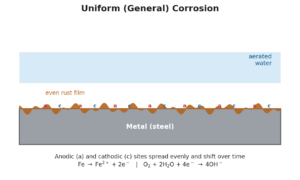 Figure 1. Schematic of uniform corrosion: anodic and cathodic micro-sites distributed evenly across the surface, producing a uniform rust film.
Origin
Uniform corrosion arises when a metal surface is exposed evenly to a corrosive environment (moisture, oxygen, acids, or atmospheric pollutants). Because the surface is chemically and microstructurally near-homogeneous, anodic and cathodic sites form as countless microscopic cells that constantly shift location across the surface, so material loss averages out evenly rather than concentrating in one spot.
Physical Explanation
Material is removed at a roughly constant rate across the entire exposed area, progressively thinning the component. AMPP (formerly NACE International) confirms that uniform corrosion “proceeds evenly over the entire surface area, or a large fraction of the total area,” with general thinning continuing until failure, and notes it accounts for the greatest tonnage of metal lost to corrosion worldwide, even though it is the least destructive form per incident. Because the rate is statistically predictable, it can be quantified using standard coupon tests and expressed in mm/year or mils-per-year (mpy).
Chemical Explanation
In neutral, aerated aqueous environments, the classic electrochemical corrosion of iron/steel proceeds via coupled anodic and cathodic half-reactions occurring at randomly distributed micro-sites (caused by grain-structure variation, inclusions, and alloying inhomogeneities):
Anodic (oxidation): Fe → Fe²⁺ + 2e⁻
Cathodic (oxygen reduction): O₂ + 2H₂O + 4e⁻ → 4OH⁻
Overall: 2Fe + O₂ + 2H₂O → 2Fe(OH)₂ → (further oxidation) → Fe₂O₃·xH₂O (rust)
Real-World Examples
- Atmospheric rusting of unprotected mild-steel structures (railings, gates, structural beams)
- General thinning of ship ballast-tank steel plating, producing rough, non-protective rust scale (ScienceDirect, marine corrosion literature)
- Uniform wall-thickness loss in carbon-steel pipelines carrying mildly acidic process water
Literature Verification
Confirmed by AMPP/NACE International [1] and by the ScienceDirect Topics entry on General Corrosion, which describes it as the most common corrosion form in ship structures and nuclear-industry components, proceeding uniformly across the exposed surface [2].
2. Pitting Corrosion
Risk Level: High — often invisible until sudden through-wall failure |
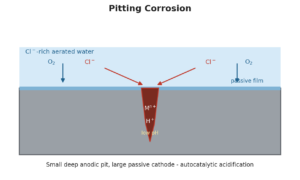 Figure 2. Schematic of pitting corrosion: a local passive-film breakdown forms a small deep anodic pit with chloride migration and internal acidification.
Origin
Pitting initiates at local breakdowns of a protective passive oxide film — at inclusions (e.g. MnS), scratches, or coating defects — typically in the presence of aggressive halide ions, especially chloride (Cl⁻). Chloride ions are small enough to penetrate the passive layer and prevent its repair (repassivation), most commonly on stainless steels and aluminum alloys.
Physical Explanation
Attack concentrates into small, deep cavities while the surrounding passive surface remains largely intact, creating a highly unfavourable small-anode/large-cathode area ratio that drives intense, self-accelerating localized dissolution. Wikipedia’s technical summary and multiple peer-reviewed studies describe this as an autocatalytic process driven by stochastic formation of separate anodic (pit) and cathodic (surrounding passive surface) zones, consistent with the point-defect model developed by Digby Macdonald.
Chemical Explanation
Hoar’s 1937 autocatalytic pit-propagation model, still the standard mechanistic reference, explains pit growth through local acidification:
Anodic (inside pit, O₂-depleted): M → Mⁿ⁺ + ne⁻
Cl⁻ migrates into the pit to balance the excess positive charge
Hydrolysis: Mⁿ⁺ + nH₂O → M(OH)ₙ↓ + nH⁺ (local pH drops, autocatalytic acceleration)
Cathodic (outside pit, on passive surface): O₂ + 2H₂O + 4e⁻ → 4OH⁻
Real-World Examples
- Chloride-driven pitting failure of gas/oil transmission pipeline steel after ~10 years of service, confirmed by SEM/XRD analysis showing akaganeite (β-FeOOH) corrosion products
- Stainless steel (304/316) water tanks and piping failing from chloride-contaminated water
- Pitting of ship propeller shafts and hulls exposed to seawater
Literature Verification
Verified by a 2025 ScienceDirect field study on chloride-accelerated pitting in pipeline steel [3], the ScienceDirect Topics overview of pitting corrosion describing the autocatalytic chloride mechanism [4], Hoar’s autocatalytic model as reviewed in a supercritical-CO₂ pitting study [5], and the Wikipedia technical summary of pitting corrosion mechanisms [6].
3. Galvanic Corrosion
Risk Level: Medium — preventable through material selection and isolation |
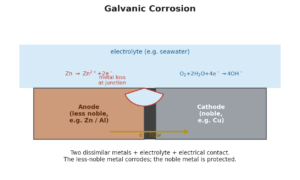 Figure 3. Schematic of galvanic corrosion: the less-noble metal (anode) corrodes while the noble metal (cathode) is protected; electrons flow through the junction.
Origin
Galvanic corrosion occurs when two dissimilar metals with different electrochemical potentials are electrically connected in the presence of a common electrolyte. NASA’s Fastener Design Manual and multiple engineering standards confirm three requirements are needed: (1) materials with different surface potentials, (2) a common electrolyte, and (3) a common electrical path between them.
Physical Explanation
The two metals form a galvanic cell: the more active (less noble) metal becomes the anode and corrodes preferentially, while the more noble metal becomes the cathode and is effectively protected. The severity depends on the potential difference (per the galvanic series), the cathode-to-anode surface area ratio (a large cathode relative to a small anode strongly accelerates anodic attack), electrolyte conductivity, and geometry/design of the joint.
Chemical Explanation
For a typical zinc–iron/steel or zinc–copper couple:
Anode (less noble, e.g. zinc): Zn → Zn²⁺ + 2e⁻
Cathode (more noble, e.g. copper or steel): O₂ + 2H₂O + 4e⁻ → 4OH⁻
Electrons flow anode → cathode through the metallic contact, driving accelerated anodic dissolution
Real-World Examples
- Steel pipe fittings connected to copper piping corroding rapidly at the joint
- Aluminum rivets/fasteners corroding around steel or stainless-steel structural plates
- Zinc sacrificial anodes intentionally corroding to protect steel ship hulls (cathodic protection application)
- Kovar electronic leads suffering galvanic attack when coupled with gold/nickel plating (NASA spacecraft hardware case study)
Literature Verification
Confirmed by NASA’s Fastener Design Manual (RP-1228) [7], the ScienceDirect Topics entry on galvanic corrosion covering area-ratio and geometry effects [8], and the SSINA (Specialty Steel Industry of North America) technical guide on the galvanic series [9].
4. Crevice Corrosion
Risk Level: High — common and hidden in flanged joints and fittings |
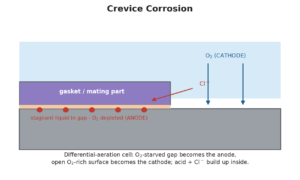 Figure 4. Schematic of crevice corrosion: the oxygen-depleted gap acts as the anode while the open, oxygenated surface acts as the cathode (differential-aeration cell).
Origin
Crevice corrosion develops in narrow gaps or shielded areas — gasketed flanges, bolted joints, lap joints, under deposits or fouling — where stagnant electrolyte collects and mass transport (especially oxygen diffusion) with the bulk environment is severely restricted.
Physical Explanation
ScienceDirect’s technical review breaks the mechanism into four stages: (1) deoxygenation of the crevice, (2) increasing local concentration of acids and aggressive salts, (3) depassivation of the metal surface, and (4) propagation of attack. Because convection between the occluded crevice and the bulk fluid is slow, dissolved oxygen inside is rapidly consumed and not replenished, while the open surface outside continues to reduce oxygen freely — establishing a differential aeration cell (crevice = anode, external surface = cathode). This mechanism is closely related to pitting corrosion but is geometry-driven rather than film-defect-driven.
Chemical Explanation
Consistent with the Critical Crevice Solution (CCS) theory:
Anodic (inside crevice, O₂-depleted): M → Mⁿ⁺ + ne⁻
Cl⁻ migrates in to preserve electroneutrality; hydrolysis: Mⁿ⁺ + H₂O → MOH + H⁺ (local acidification)
Cathodic (outside crevice, oxygenated): O₂ + 2H₂O + 4e⁻ → 4OH⁻
Real-World Examples
- Corrosion beneath rubber gaskets in bolted/flanged pipe joints — a documented failure mode in super-duplex stainless steel (UNS S32760) flanges
- Corrosion under bolt heads, washers, and loose-fitting rolled joints in steam/condensate systems
- Attack beneath marine biofouling or moist thermal insulation (crevice corrosion under insulation, CUI)
Literature Verification
Confirmed by the ScienceDirect Topics entry on crevice corrosion describing the four-stage CCS mechanism [10], a 2024 ScienceDirect review of corrosion failures in flanged gasketed joints [11], and AMPP’s Materials Performance technical article on crevice corrosion [12].
5. Microbiologically Influenced Corrosion (MIC)
Risk Level: Very High — accelerated, localized, and difficult to predict |
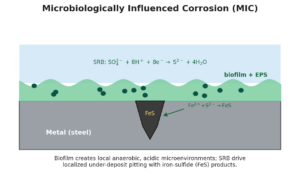 Figure 5. Schematic of MIC: a biofilm/EPS layer creates local anaerobic, acidic microenvironments where SRB drive under-deposit pitting and iron-sulfide formation.
Real example — MIC of a steel quay wall: the black iron-sulfide (FeS) layer, through-wall perforations, and (green circle) shiny steel exposed where the MIC layer was removed. Source: Koerdt, Knisz, Wade & Silva (Eds.), Microbiologically Influenced Corrosion (CRC Press, 2026), Fig. 8.5, open access CC BY-NC-ND 4.0.
Origin
MIC is corrosion influenced or accelerated by the metabolic activity of microorganisms (bacteria, archaea, fungi) that colonize a metal surface and form a biofilm. It is common in stagnant or low-flow water systems, buried pipelines, oil & gas infrastructure, and cooling systems. Sulfate-reducing bacteria (SRB), such as Desulfovibrio species, are among the most studied and economically damaging contributors — the U.S. Air Force alone reportedly spends roughly $1 billion annually addressing SRB-driven MIC.
Physical Explanation
Biofilms create localized microenvironments with pH, oxygen, and dissolved-species concentrations that differ sharply from the bulk fluid. Peer-reviewed studies show biotic (microbially colonized) steel coupons develop substantially higher pit density and depth than abiotic controls (one study reported 15–47 pits/mm² under biofilm versus ~3 pits/mm² without). Aerobic biofilm patches can also create their own differential-aeration cells: oxygen-depleted zones beneath the biofilm become anodic while adjacent uncolonized, oxygen-rich zones become cathodic.
Chemical Explanation
SRB drive corrosion primarily through sulfate reduction coupled to iron oxidation (multiple proposed mechanisms, including cathodic depolarization and biocatalytic cathodic sulfate reduction):
Sulfate reduction (using organic donors, e.g. lactate): SO₄²⁻ + 8H⁺ + 8e⁻ → S²⁻ + 4H₂O
Sulfide reacts with dissolved iron: Fe²⁺ + S²⁻ → FeS (mackinawite / iron sulfide corrosion product)
Net iron oxidation is thermodynamically coupled to bacterial sulfate reduction at the metal surface
Real-World Examples
- SRB-driven internal corrosion of buried oil and gas transmission pipelines
- Accelerated corrosion in cooling-tower and process water systems supporting mixed microbial biofilms
- Under-tubercle corrosion (FeS/iron-oxide tubercles) on steel water/wastewater infrastructure
- Failures of stainless steel components in marine and offshore structures linked to SRB colonization
Literature Verification
Confirmed by a 2025 open-access study in npj Materials Degradation (Nature) on biofilm/MIC interactions on carbon steel [13], a peer-reviewed review of SRB impact on steel corrosion [14], a PMC study quantifying pit density under SRB biofilms [15], and the FEMS Microbiology Reviews (Oxford Academic) overview of MIC mechanisms [16].
Featured Reference Book: A Comprehensive Guide to MIC
<link to download pdf>
Koerdt, A., Knisz, J., Wade, S., & Silva, E. R. (Eds.) (2026). Microbiologically Influenced Corrosion: A Comprehensive Guide to Principles, Assessment and Mitigation (1st ed.). CRC Press / Taylor & Francis. 445 pp. ISBN 978-1-032-70799-0. DOI: 10.1201/9781032708010. Open Access (CC BY-NC-ND 4.0).
The following summary is drawn directly from the attached 445-page volume, which serves as the flagship deliverable of the EU-funded COST Action CA20130 (“Euro-MIC”). Unlike a conventional textbook, it is written as an interdisciplinary practical guide bridging microbiology, materials science, and engineering.
Purpose and Central Thesis
The book argues that microbiologically influenced corrosion (MIC) — the largely negative effect microorganisms exert on materials — has historically been studied in a fragmented, siloed way, with true interdisciplinarity being the exception rather than the rule. Its central thesis is that MIC can only be understood and managed through sustained collaboration across materials science, chemistry, microbiology, and engineering. A recurring theme is that conventional material-lifetime calculations often exclude biological factors entirely, which can lead to unexpectedly accelerated failures because real service environments contain far more biological complexity than controlled laboratory settings anticipate.
The Core Challenge: Complexity and Uncertainty
A key message running through the volume is that MIC is inherently difficult to predict. Microbial communities are ubiquitous and highly adaptable, and their composition and activity depend on habitat-specific factors such as nutrient availability, temperature, pH, water content, and pressure. The book highlights a critical knowledge gap: only a small fraction of microbial species (roughly 1–5%) can currently be cultured or enriched, and while 16S rRNA sequencing identifies many organisms, little is often known about their metabolism or whether they are aerobic or anaerobic. It also stresses a fundamental mismatch in timescales — materials science benefits from accelerated testing that simulates decades of degradation quickly, whereas biological processes cannot be authentically accelerated, making standardized MIC testing especially challenging.
Mechanistic Understanding
Building on the historical identification of sulfate-reducing bacteria (SRB) as key culprits, the book emphasizes that MIC is rarely a single mechanism but rather a combination of processes operating together. Central to this is the biofilm and its extracellular polymeric substance (EPS) matrix, which does not merely anchor cells but actively reshapes the local chemical microenvironment — altering pH, oxygen concentration, and chemical composition at the metal surface. Aerobic organisms near the surface can consume oxygen and create anaerobic niches where SRB and corrosive methanogenic archaea thrive, generating corrosive by-products such as hydrogen sulfide, organic acids, and ammonia that drive the underlying electrochemical reactions. The editors’ own research (notably Koerdt’s work at BAM) extends the classical SRB picture to include corrosive methanogenic archaea across energy sectors.
Structure and Key Themes by Chapter
- Chapter 1 — A brief history of MIC research, with personal reflections from long-standing figures in the field.
- Chapter 2 — MIC principles and current perspectives: biofilms, EPS, microbial metabolism, and the electrochemistry linking them to corrosion.
- Chapter 3 — Integrated analysis and diagnosis of corrosion causes, informed by the latest analytical techniques (Skovhus & Eckert).
- Chapter 4 — Feasibility and sustainability of MIC monitoring methods.
- Chapter 5 — Methods in MIC mitigation and prevention (the largest contributor list, reflecting the emphasis on green, sustainable mitigation).
- Chapter 6 — Standardization: the current status of MIC standards, gaps, and how to improve them (engaging AMPP, CEN, ISO, and DIN).
- Chapter 7 — Sector-specific insights into monitoring and management across different industries.
- Chapter 8 — A case-study approach bridging theory and practice in MIC management.
- Chapter 9 & Conclusion — Current challenges and the future of MIC research.
- Appendices A–H — Expert interviews (e.g. Brenda Little, Richard Eckert), a cross-sector round-table survey, and a proposed laboratory MIC test protocol using field-sampled microbial consortia.
The “Multiple Lines of Evidence” (MLOE) Approach
A methodological cornerstone advocated throughout the book — particularly associated with co-editor Judit Knisz — is the Multiple Lines of Evidence (MLOE) approach. Because no single test can definitively confirm MIC, the book recommends correlating several independent forms of evidence: identifying whether MIC actually caused the damage, detecting characteristic by-products, correlating them with the microorganisms present, and identifying the conditions that support MIC. This diagnostic philosophy underpins the book’s practical guidance on distinguishing MIC from purely abiotic electrochemical corrosion.
Practical Orientation and Intended Audience
The editors are explicit that this is a practical guide rather than a traditional teaching text. It aims to provide concrete steps to take when damage occurs and MIC is suspected, important professional contacts, a listing of current MIC-related standards, key professional societies, and pointers to the best available reviews. It is aimed at two main audiences: young scientists curious about MIC who want an accessible entry point, and practicing professionals facing a specific MIC case who are unsure which approach or standards to apply. The book candidly acknowledges it cannot offer permanent solutions or guarantee immunity from MIC, but positions itself as a tool to minimize challenges and improve diagnosis and mitigation.
Significance
As an open-access output of a four-year, ~400-member European network (Euro-MIC, 2021–2025) that produced over 50 peer-reviewed publications, the book represents a consolidated, current state-of-the-field reference. It explicitly aims to reduce Europe’s historical dependence on North American and Australian MIC frameworks by developing prevention measures and standards aligned with European regulations (for example, constraints on biocide use). Its interdisciplinary, network-driven character is both its distinguishing feature and its central argument for how the field should advance.
References
All references were retrieved and verified in July 2026. Links point to publicly accessible pages; some ScienceDirect/Springer/Taylor & Francis articles may require institutional access for full text.
[1] AMPP (NACE International). “Uniform Corrosion.” https://www.nace.org/resources/general-resources/uniform-corrosion
[2] ScienceDirect Topics. “General Corrosion — an overview.” https://www.sciencedirect.com/topics/engineering/general-corrosion
[3] ScienceDirect (2025). “Mechanisms and evidence of chloride-accelerated pitting in gas pipeline steel.” https://www.sciencedirect.com/science/article/pii/S1350630725006855
[4] ScienceDirect Topics. “Pitting Corrosion — an overview.” https://www.sciencedirect.com/topics/chemistry/pitting-corrosion
[5] ScienceDirect. “Understanding the pitting corrosion mechanism of pipeline steel in an impure supercritical CO2 environment.” https://www.sciencedirect.com/science/article/abs/pii/S0896844617307921
[6] Wikipedia. “Pitting corrosion.” https://en.wikipedia.org/wiki/Pitting_corrosion
[7] NASA Reference Publication 1228. “Fastener Design Manual.” https://ntrs.nasa.gov/api/citations/19900009424/downloads/19900009424.pdf
[8] ScienceDirect Topics. “Galvanic Corrosion — an overview.” https://www.sciencedirect.com/topics/materials-science/galvanic-corrosion
[9] SSINA (Specialty Steel Industry of North America). “Galvanic Corrosion.” https://www.ssina.com/education/corrosion/galvanic-corrosion/
[10] ScienceDirect Topics. “Crevice Corrosion — an overview.” https://www.sciencedirect.com/topics/materials-science/crevice-corrosion
[11] ScienceDirect (2024). “Corrosion failures of flanged gasketed joints: A review.” https://www.sciencedirect.com/science/article/pii/S2666330924000177
[12] AMPP Materials Performance (2024). “Crevice Corrosion.” https://content.ampp.org/materials-performance/article-pdf/63/1/72/579108/mp2024_63_1-72.pdf
[13] Nature — npj Materials Degradation (2024). “Dual anaerobic reactor model to study biofilm and microbiologically influenced corrosion interactions on carbon steel.” https://www.nature.com/articles/s41529-024-00542-x
[14] Taylor & Francis — Biofouling (2021). “Biofilms and beyond: a comprehensive review of the impact of Sulphate Reducing Bacteria on steel corrosion.” https://www.tandfonline.com/doi/full/10.1080/08927014.2023.2284316
[15] PMC / NCBI (2025). “Effects of Sulphate-Reducing Bacteria Mixed-Species Biofilms on Microbiologically Influenced Corrosion.” https://pmc.ncbi.nlm.nih.gov/articles/PMC12366542/
[16] FEMS Microbiology Reviews, Oxford Academic (2023). “Microbiologically influenced corrosion—more than just microorganisms.” https://academic.oup.com/femsre/article/47/5/fuad041/7223462
Featured Book (attached PDF)
[17] Koerdt, A., Knisz, J., Wade, S., & Silva, E. R. (Eds.) (2026). Microbiologically Influenced Corrosion: A Comprehensive Guide to Principles, Assessment and Mitigation (1st ed.). CRC Press. DOI: 10.1201/9781032708010. https://doi.org/10.1201/9781032708010
[18] Open-access full text (Taylor & Francis, CC BY-NC-ND 4.0). https://www.taylorfrancis.com/books/oa-edit/10.1201/9781032708010/microbiologically-influenced-corrosion-andrea-koerdt-judit-knisz-scott-wade-elisabete-silva
[19] Publisher page (Routledge / CRC Press), incl. book description and editor biographies. https://www.routledge.com/Microbiologically-Influenced-Corrosion-A-Comprehensive-Guide-to-Principles-Assessment-and-Mitigation/Koerdt-Knisz-Wade-RSilva/p/book/9781032707990
[20] Knisz, J., Eckert, R., Gieg, L. M., Koerdt, A., et al. (2023). “Microbiologically influenced corrosion—more than just microorganisms.” FEMS Microbiology Reviews (foundational review by the book’s editors / Euro-MIC network). DOI: 10.1093/femsre/fuad041. https://doi.org/10.1093/femsre/fuad041
[21] COST Action CA20130 “Euro-MIC” — European MIC Network (project background). https://www.cost.eu/actions/CA20130/
Photograph Sources (recommended freely-licensed real examples)
[P1] Uniform / general corrosion — “Verrostete Eisenplatte.jpg” (uniformly rusted iron plate), Category: Corroded objects. https://commons.wikimedia.org/wiki/Category:Corroded_objects
[P2] Pitting corrosion — “Pitting corrosion on duplex stainless steel specimens.jpg” (CC BY 4.0). https://commons.wikimedia.org/wiki/File:Pitting_corrosion_on_duplex_stainless_steel_specimens.jpg

[P3] Galvanic corrosion — “Galvanic corrosion between steel and aluminum in seawater.png”, Category: Galvanic corrosion. https://commons.wikimedia.org/wiki/Category:Galvanic_corrosion
[P4] Crevice corrosion — “Crevice corrosion of 316 stainless steel in desalination.jpg”, Category: Corroded objects. https://commons.wikimedia.org/wiki/Category:Corroded_objects
[P5] MIC (additional) — “Pipeline video inspection – pitting corrosion.png” (CC BY-SA 4.0). https://commons.wikimedia.org/wiki/File:Pipeline_video_inspection_-_pitting_corrosion.png
